
Pathogenesis of Type 2 Diabetes Mellitus:
What is Type 2 Diabetes Mellitus?
Type 2 Diabetes Mellitus is a complex disease with no evidence of an autoimmune basis in contrast to type 1 diabetes mellitus. Instead, it involves an interplay of genetic and environmental factors, often seen in obese patients over 40 years of age, though it can also affect children and adolescents.
What role do genetic factors play in Type 2 Diabetes?
Genetic susceptibility is significant:
If a first-degree relative has Type 2 diabetes, the risk increases by 5 to 10 times.
Twin studies show that if one identical twin has Type 2 diabetes, the other twin has a >90% chance of developing it.
Genome-wide association studies have identified at least 30 loci in DNA that increase the risk of developing Type 2 diabetes. These genes are involved in adipose tissue function, beta-cell function, and obesity.
How do environmental factors contribute to Type 2 Diabetes?
Environmental factors, or risk factors, are the primary contributors. These include:
Obesity: Central (visceral) obesity is the most critical risk factor. Over 80% of individuals with Type 2 diabetes are obese. Obesity leads to insulin resistance.
Sedentary Lifestyle: Lack of physical activity increases the risk of insulin resistance, even in non-obese individuals. Weight loss and exercise improve insulin sensitivity.
Metabolic Syndrome: This includes central obesity, high blood pressure, high blood sugar, and increased cholesterol and triglyceride levels. Together, these increase the risk significantly.
Ethnicity: Certain ethnic groups, such as East Asians, South Asians, and Middle Eastern populations, have a higher prevalence of Type 2 diabetes, often independent of body mass index (BMI).
Sleep Disorders and Circadian Disruption: Conditions like obstructive sleep apnea and misalignment of circadian rhythms (e.g., night shift workers) impair glucose homeostasis, affecting both insulin secretion and action.
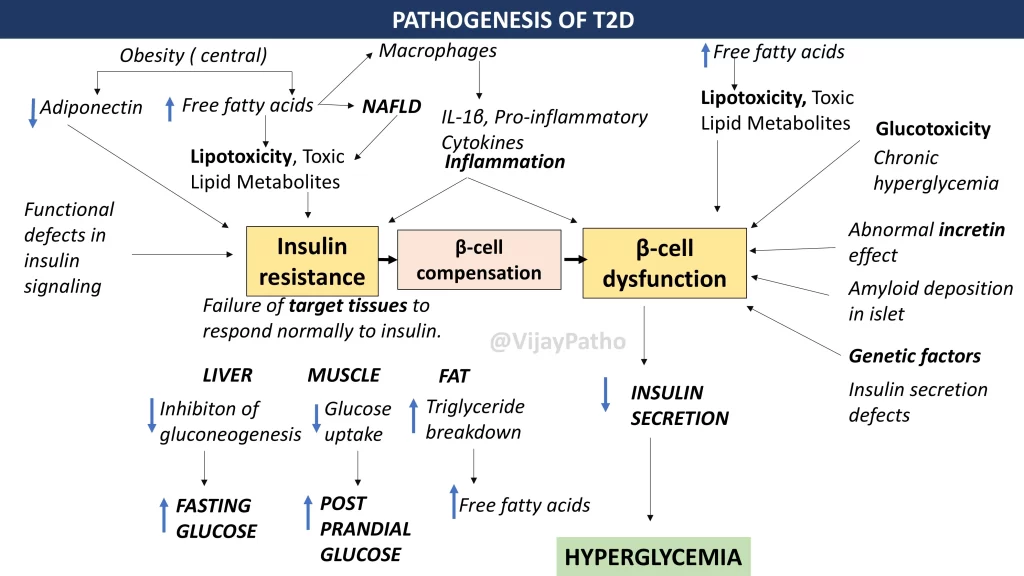
What are the main metabolic defects in Type 2 Diabetes?
The two critical metabolic defects are:
Insulin Resistance:
Target tissues (liver, skeletal muscle, and adipose tissue) fail to respond normally to insulin.
In the liver: Decreased inhibition of gluconeogenesis leads to increased fasting glucose levels.
In muscles: Reduced glucose uptake after meals increases postprandial glucose levels.
In adipose tissue: Increased breakdown of triglycerides raises free fatty acid levels, contributing to insulin resistance.
Beta-cell Dysfunction:
Decreased insulin secretion leads to hyperglycemia.
Prolonged insulin resistance exhausts beta cells, causing their dysfunction.
What causes insulin resistance?
Key causes include:
Central Obesity: Leads to decreased adiponectin and increased free fatty acids, which generate toxic lipid metabolites (lipotoxicity).
Pro-inflammatory State: Elevated free fatty acids stimulate macrophages to produce inflammatory cytokines like interleukin-1β, further contributing to insulin resistance.
Defects in Insulin Signaling Pathways: Functional impairments in these pathways exacerbate resistance.
What contributes to beta-cell dysfunction?
Lipotoxicity: Toxic lipid metabolites from increased free fatty acids impair beta-cell function.
Chronic Hyperglycemia: Sustained high blood sugar damages beta cells.
Abnormal Incretin Effect: Incretins (like GLP-1 and GIP), which enhance insulin secretion after meals, are reduced in Type 2 diabetes.
Amyloid Deposition: Deposits in pancreatic islets impair beta-cell function.
Genetic Factors: Inherited defects in insulin secretion contribute to dysfunction.
What is the progression of Type 2 Diabetes?
Initially, beta cells compensate for insulin resistance by producing more insulin, leading to beta-cell hyperplasia. Over time, this compensation fails as beta cells become exhausted, leading to reduced insulin secretion and persistent hyperglycemia.