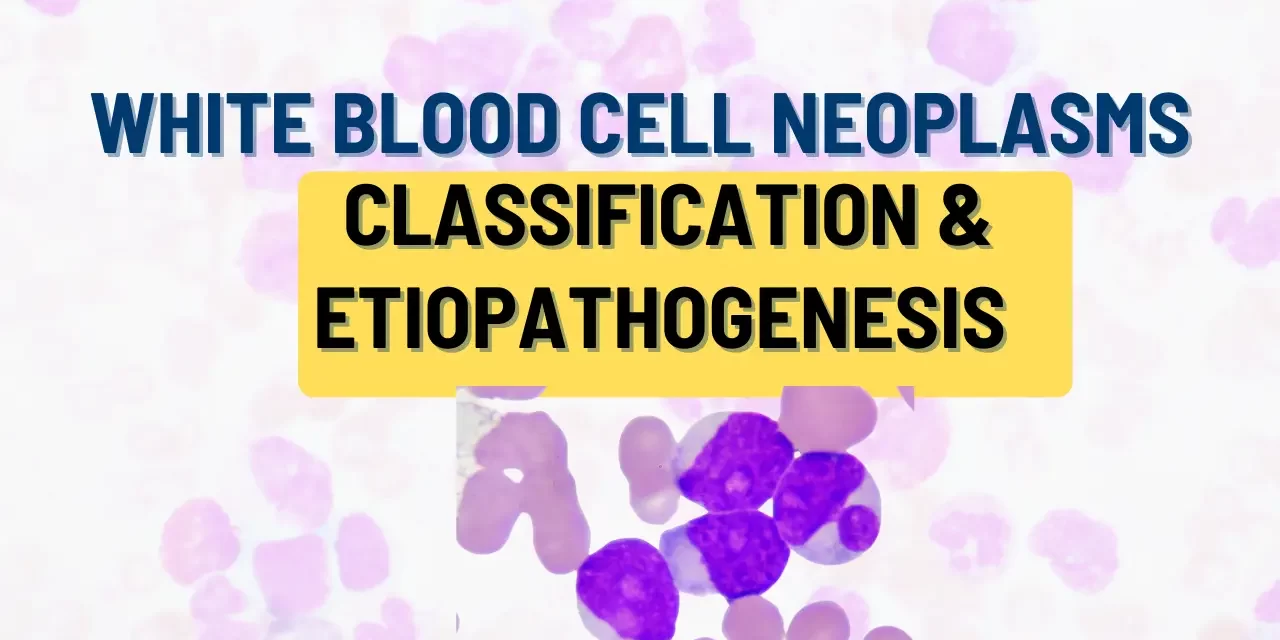
White Blood Cell Neoplasms: Classification and General Etiopathogenesis
Welcome to a new series on White Blood Cell (WBC) Neoplasms, one of the most important and often feared topics in pathology. This guide simplifies the classification and general causes (etiopathogenesis) of WBC neoplasms.
Introduction to White Blood Cell Neoplasms
White blood cell neoplasms refer to cancers or tumors involving white blood cells. These are broadly classified into:
– Lymphoid neoplasms – cancers of B cells, T cells, or NK (natural killer) cells
– Myeloid neoplasms – cancers arising from early progenitor cells in the bone marrow
– Histiocytoses – proliferative conditions involving macrophages and dendritic cells
Types of Myeloid Neoplasms
Myeloid neoplasms are further categorized into:
– Acute myeloid leukemia (AML)
– Myelodysplastic syndromes (MDS)
– Myeloproliferative neoplasms (MPN)

Click below to learn the differences between MDS and MPN
Etiopathogenesis of white blood cell neoplasms:
What Causes white blood cell neoplasms
Let’s now explore the common causes of white blood cell cancers, grouped into broad categories. For more on this topic, make sure to check out this contact form.
1. Chromosomal Translocations & Acquired Mutations
Many WBC neoplasms arise due to changes in genes. These changes can be categorized into three types of mutations:
a. Pro-growth mutations – push cells to divide uncontrollably (e.g., tyrosine kinase mutations, MYC translocations)
b. Self-renewal mutations – make cells act like stem cells (e.g., KMT2A, PML-RARA)
c. Pro-survival mutations – prevent tumor cells from dying (e.g., BCL2 translocation)
These changes form oncogenic proteins that:
– Cause maturation arrest
– Activate growth signaling
– Prevent cell death (apoptosis)
2. Errors During Normal Immune Responses
Activation-Induced Cytidine Deaminase (AID) helps in:
– Class switching (e.g., IgM → IgG)
– Somatic hypermutation to improve antibody affinity
But when AID goes wrong, it can cause harmful mutations, such as MYC-Ig translocation and BCL6 overexpression, leading to lymphomas.
3. Inherited Genetic Syndromes
Certain conditions promote genomic instability and increase leukemia risk:
– Bloom syndrome
– Fanconi anemia
– Ataxia telangiectasia
– Down syndrome
– Neurofibromatosis type 1
4. Viral Infections
Linked viruses include:
– HTLV-1 → T-cell leukemia/lymphoma
– EBV → Burkitt lymphoma, Hodgkin lymphoma, NK cell lymphoma
– HHV-8 → B-cell lymphoma (e.g., primary effusion lymphoma)
5. Chronic Inflammation
Examples of inflammation-linked cancers:
– H. pylori → Gastric MALT lymphoma
– Gluten-sensitive enteropathy → Intestinal T-cell lymphoma
– Breast implants → T-cell lymphoma
– HIV → B-cell lymphoma
6. Iatrogenic Factors
Radiotherapy and chemotherapy can damage hematopoietic progenitor cells, leading to:
– Myeloid neoplasms
– Lymphoid neoplasms
7. Smoking
Benzene in tobacco smoke increases the risk of AML by 1.3 to 2 times.
click below to watch the video tutorial on white blood cell neoplasms