Pyroptosis Explained | Pathology Made Simple
What Is Pyroptosis?
The word “pyro” means fire or fever.
Pyroptosis is a fiery type of cell death—a lytic, inflammatory, yet programmed form of cell death.
The key things to remember are:
-
It is programmed, like apoptosis.
-
It is inflammatory, unlike apoptosis.
-
It is lytic, with membrane pores that eventually rupture.
The hallmark event in pyroptosis is the release of Interleukin-1β (IL-1β), an important cytokine responsible for fever and leukocyte recruitment.
Why Does Pyroptosis Occur?
Pyroptosis mainly acts as a defense mechanism.
When a cell is infected—often by bacteria—the body needs a way to:
-
Kill the infected cell
-
Alert nearby immune cells
-
Limit pathogen replication
This is done through the release of IL-1β and other inflammatory mediators.
Who Performs Pyroptosis? The Executioners
The “executioner proteins” in pyroptosis are called Gasdermins (mainly Gasdermin D – GSDMD).
Once activated, Gasdermin D forms pores in the cell membrane.
These pores cause:
-
cell swelling
-
loss of osmotic balance
-
release of IL-1β
-
formation of pyroptotic bodies
-
and finally, membrane rupture
Pathways of Pyroptosis
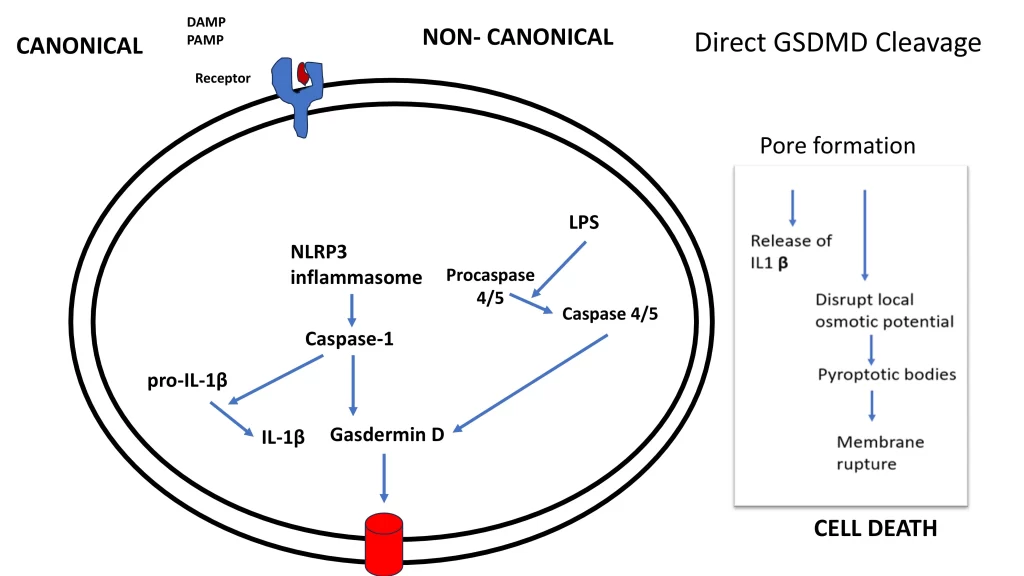
There are two major pathways, but both lead to Gasdermin D cleavage.
1. Canonical Pathway
The canonical pathway begins with NLRP3, a receptor that senses:
-
microbial proteins
-
DAMPs
-
PAMPs
Steps (simplified):
-
NLRP3 activation
-
NLRP3 polymerizes to form the inflammasome
-
Inflammasome activates Caspase-1
-
Caspase-1 converts pro-IL-1β → IL-1β
-
Caspase-1 also cleaves Gasdermin D
-
Gasdermin D forms pores in the plasma membrane
-
IL-1β escapes through these pores
-
Loss of membrane integrity causes pyroptotic bodies and cell death
2. Non-Canonical Pathway
This pathway is triggered by intracellular lipopolysaccharide (LPS) from gram-negative bacteria.
Steps:
-
LPS in cytoplasm activates pro-Caspase-4 and pro-Caspase-5
-
They convert into active Caspase-4 and Caspase-5
-
These caspases cleave Gasdermin D
-
Pore formation occurs
-
IL-1β release, membrane blebs, and eventual rupture follow
Both pathways converge on the same point: Gasdermin D activation.
Pyroptotic Bodies – What Are They?
Just like apoptosis forms apoptotic bodies, pyroptosis produces pyroptotic bodies.
These appear because the plasma membrane is damaged, leading to blebs and bulges before the membrane finally ruptures.
Where Is Pyroptosis Useful?
Pyroptosis has two major roles:
1. Host Defense
-
Kills infected cells
-
Stops pathogens from replicating
-
Recruits immune cells through IL-1β
2. Excess Activation (Disease)
Too much pyroptosis can lead to:
-
Sepsis
-
Auto-inflammatory diseases
-
Autoimmune flares
Differences: Apoptosis vs Pyroptosis vs Necroptosis
Here is a simple comparison based entirely on your explanation:
1. Basis of Activation
-
Apoptosis: Caspase-8 or Caspase-9
-
Pyroptosis: Caspase-1, Caspase-4, Caspase-5 → Gasdermin D cleavage
-
Necroptosis: RIPK1 and RIPK3 kinases
2. Membrane Integrity
-
Apoptosis: Membrane remains intact
-
Pyroptosis: Membrane damaged (Gasdermin pores)
-
Necroptosis: Membrane damaged (MLKL-induced pores)
3. Inflammation
-
Apoptosis: Minimal or no inflammation
-
Pyroptosis: Highly inflammatory (IL-1β, IL-18 release)
-
Necroptosis: Highly inflammatory (DAMPs released)
4. Type of Cell Death
All three are forms of programmed cell death, but the inflammatory nature differentiates them.
Key Take-Home Points
-
Pyroptosis is programmed but inflammatory and lytic.
-
IL-1β release is the signature event.
-
Gasdermin D is the executioner creating pores in the membrane.
-
Canonical → Caspase-1
-
Non-canonical → Caspase-4, Caspase-5
-
Both pathways lead to Gasdermin cleavage and pore formation.
-
Plays a major role in host defense but excessive activation causes sepsis and autoimmune flares.
-
Differs from apoptosis (non-inflammatory) and necroptosis (different pore-forming mechanism).
click to watch the Video tutorial on Pyroptosis